Table of contents
From the latticework of a highway overpass to the clean geometry of a glass tower, the contemporary city has become both studio and subject for a rising wave of street artists, and the shift is not just aesthetic. As public walls grow scarcer, as urban regeneration redraws neighbourhoods, and as social media rewards instantly readable forms, architecture is increasingly shaping what gets painted, where it appears, and how audiences interpret it. The street is still the canvas, but the built environment is now the brief.
Concrete, steel, and a new visual grammar
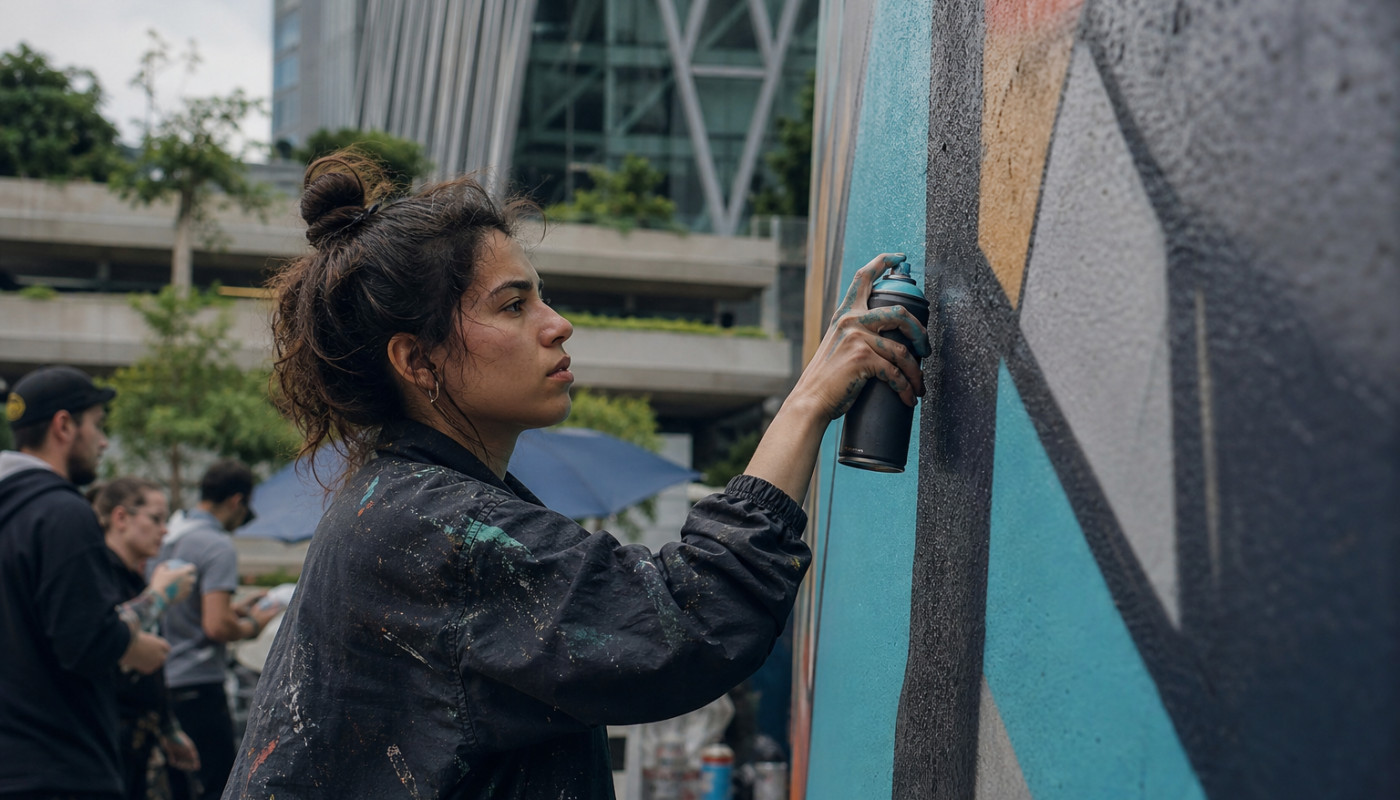
Look up, then look again. The visual language of street art is changing because the city’s surfaces, sightlines, and materials have changed, and artists are adapting with the precision of designers. Across major urban centres, large-scale murals now routinely respond to architectural constraints: expansion joints become compositional lines, window grids dictate rhythm, and the edges of a building are treated as frames rather than obstacles.
That evolution is visible in what gets painted. In many cities, the most prevalent new murals lean into geometry, high-contrast colour blocking, optical illusion, and typography engineered for distance, a practical response to taller buildings and faster streets where viewers often experience art in motion. It is also tied to the technical reality of contemporary façades. Smooth cladding, sealed brick, anti-graffiti coatings, and composite panels can be harder to paint and quicker to clean, so artists increasingly seek surfaces that can hold pigment, accept wheatpaste, or offer micro-texture for adhesion. Even the rise of “legal walls” and commissioned murals has pushed artists toward architectural thinking, because permission often comes with parameters: sightlines, branding sensitivities, and the need to “fit” the building rather than fight it.
There is a generational component, too. A younger cohort, raised on 3D software, architectural visualisations, and game environments, reads the city as a set of modular volumes, and their work borrows from that logic. Perspective tricks that extend a corridor, gradients that mimic shadow, and compositions that wrap corners are not simply stylistic flourishes; they are ways of negotiating the built environment as a spatial puzzle. In dense neighbourhoods where a mural competes with balconies, signage, and utility lines, the most successful pieces often behave like architecture themselves, creating order, guiding the eye, and offering a moment of calm amid visual noise.
The overpass became the gallery wall
Why do so many of today’s defining works appear under bridges, along rail corridors, and on the flanks of infrastructure? Because infrastructure is where the modern city inadvertently offers what artists need: scale, continuity, and a measure of tolerance. Overpasses provide long, uninterrupted planes, the kind that allow narrative sequences or repeated motifs, and their concrete surfaces can be forgiving compared with coated commercial façades.
Urban planners have long understood that infrastructure shapes movement, but street artists have understood something else: it shapes attention. A commuter on a train platform has seconds to absorb an image, which is why bold silhouettes, simplified palettes, and graphic lettering thrive in these spaces. The setting also changes the meaning. A portrait painted beside a busy arterial road reads differently from the same portrait in a pedestrian laneway; one is consumed at speed and from afar, the other invites close inspection, tags, and dialogue. The city, in other words, edits the art.
At the same time, infrastructure projects and redevelopment cycles can erase entire ecosystems of informal art overnight. When a corridor gets upgraded, surfaces are resurfaced, fences go up, and what had been a living archive of marks becomes a blank slate. That volatility has pushed some artists toward works that respond directly to the transformation itself, incorporating motifs of scaffolding, cranes, and construction patterns, or referencing local histories embedded in the street grid. In cities with aggressive anti-graffiti enforcement, the liminal spaces of infrastructure can also offer relative invisibility, not as a romantic ideal of illegality, but as a practical condition for experimentation.
What emerges is a paradox. The more a city invests in polished public realm projects, the more the raw underbelly of infrastructure can feel like the last place where spontaneous visual culture survives, and younger artists, especially, treat these zones as training grounds. They learn scale, durability, and public visibility there, and they learn to read architecture as a collaborator, not merely a backdrop.
When buildings tell artists where to look
Architecture does not just provide surfaces; it provides stories. A building signals wealth, power, heritage, abandonment, and aspiration, and street artists are increasingly attentive to those signals, using the built environment as a narrative device. A mural on a luxury development reads as commentary even when it is decorative, while a stencil on a boarded-up storefront can become a document of decline, resilience, or displacement.
This sensitivity is especially pronounced in districts undergoing rapid change, where architecture becomes a proxy for conflict: longtime residents versus newcomers, independent businesses versus chains, informal culture versus curated “placemaking.” Street art often lands in the middle of that struggle, sometimes used by developers and municipalities to brand an area as creative, sometimes used by artists to question who the city is being built for. The tension is not theoretical; it plays out in the choice of wall, the content of the image, and the life span the artist expects. A piece intended to last may be designed to harmonise with the façade, while a piece intended as interruption may deliberately clash with the building’s palette or geometry.
The relationship is also becoming more explicit through site-specific work, where artists build compositions around architectural quirks: a circular window becomes an eye, a staircase becomes a spine, a column becomes a totem. This is not new in principle, but it has accelerated as cities have embraced mural programmes and as artists have become more mobile, travelling to paint festivals and commissions that demand architectural responsiveness. The city turns into a brief, and the brief is increasingly about integration: how to make the work legible from multiple angles, how to address pedestrian and vehicle flows, and how to respect, or subvert, the building’s intended message.
Montreal offers a particularly rich case study because its built environment juxtaposes historical masonry, bold contemporary interventions, and an outdoor mural culture with international reach. For readers interested in how architecture and art intertwine in settings designed to astonish, Cult MTL has explored how design choices in entertainment complexes can be engineered for impact, a reminder that spectacle architecture and public-facing art often share the same goal: to choreograph attention.
From sketchbook to skyline, the tools changed
It is tempting to frame the new architectural influence as purely cultural, but technology is a major driver, and younger artists are often the quickest to exploit it. Digital mock-ups allow painters to test how a design will sit on a façade before a single line is drawn, and drone photos, satellite imagery, and 3D mapping tools make it easier to plan for scale, distortion, and viewing angles. The result is a generation of street artists who approach walls like designers approach elevations, measuring proportions, anticipating shadows, and planning colour interactions with adjacent materials.
That technical shift also changes what gets valued. Photogenic work travels farther online, and architecture-heavy compositions, clean lines, strong perspective, and bold colour fields tend to read well on screens. Social platforms reward work that looks complete, legible, and “finished,” which can push artists toward architectural aesthetics even when working in gritty spaces. Yet the street still asserts itself. Weathering, sunlight, grime, and the constant possibility of removal mean that durability matters, and artists choose paints, sealants, and techniques with an eye to how a piece will age on a particular surface.
Economics plays a role as well. Large walls are rarely accessible without equipment, permits, or partnerships, and that reality nudges emerging artists toward a semi-professional workflow earlier in their careers. Lifts, scaffolds, and safety requirements turn the act of painting into a logistical project, and architecture becomes not only inspiration but constraint: where can the lift go, what can be reached, what is safe, what is visible. In cities where public art budgets have expanded, murals are often commissioned as part of regeneration strategies, and the brief may include community consultation, heritage sensitivity, or integration with the building’s design intent. For some artists, that is an opportunity to reach new audiences; for others, it is a negotiation over control.
Still, the underlying dynamic remains: the city is being rebuilt, and the art is learning to speak its language. Street artists are not abandoning spontaneity, humour, or critique, but many are adopting the discipline of architectural thinking, because the walls themselves demand it. In the process, urban architecture is no longer just the setting of street art; it is one of its most powerful collaborators.
Planning a street-art trip without wasting it
To see architecture-driven street art at its best, start with a neighbourhood plan, not a single address, and budget time for detours because the strongest pieces often sit just off main corridors. Many cities publish mural maps and festival routes, while local transit day passes can be cheaper than rideshares for hopping between districts. Check whether guided tours operate seasonally, and look for municipal or cultural grants if you are organising a community visit, as some programmes subsidise educational groups.
Similar articles

Exploring The Impact Of AI On Traditional Drawing And Artistic Methods

Exploring The Impact Of AI On Traditional Art Forms: A Comparative Study

The Symbolism Of Alexandre Cabanel's Fallen Angel: Decoding The Imagery

Exploring The Role Of Birthmarks In Identifying Starseeds
